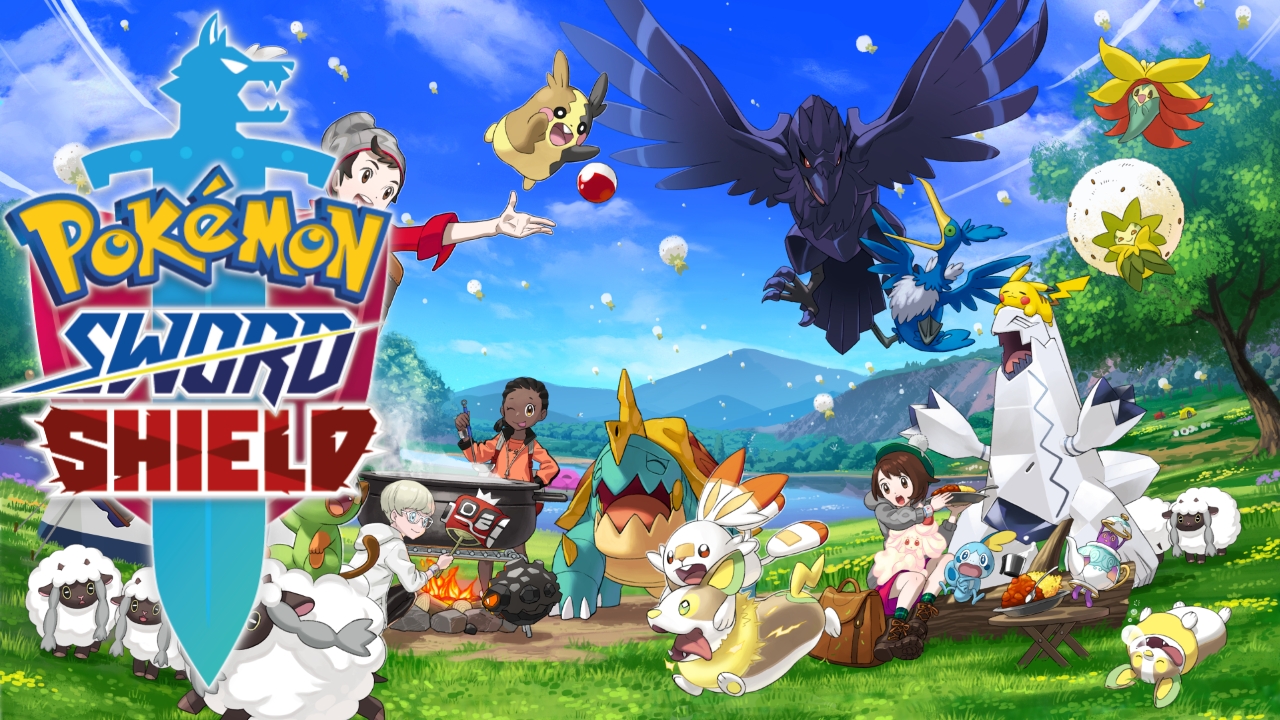
Pokémon Sword[a] and Pokémon Shield[b] are 2019 role-playing video games developed by Game Freak and published by The Pokémon Company and Nintendo for the Nintendo Switch. They are the first installments in the eighth generation of the Pokémon video game series and the second in the series, following Pokémon: Let’s Go, Pikachu! and Let’s Go, Eevee!, released on a home game console. Originally teased at E3 2017 and announced in February 2019, Pokémon Sword and Shield were released in November 2019. The games received two downloadable content expansion packs through an expansion pass with the The Isle of Armor, released in June 2020 and The Crown Tundra, released in October 2020. A physical bundle including both expansion packs with the base games was released in November 2020.Sword and Shield’s concept planning began immediately following the completion of Pokémon Sun and Moon in 2016, while full production began a year later in September 2017. Like previous installments, they chronicle the journey of a young Pokémon trainer aiming to become the Pokémon Champion, this time in the new Galar region, which is based on the United Kingdom. The main objective of the games is to dethrone the Pokémon League Champion, Leon, in a tournament that various other Gym Leaders and rivals also take part in, whilst dealing with Team Yell and a nefarious conspiracy within the League. Sword and Shield introduce 81 new Pokémon alongside 13 regional forms of pre-existing Pokémon; Dynamaxing, which increases the size of Pokémon under certain conditions; Gigantamaxing, which additionally changes the form of certain Pokémon; and the Wild Area, which is a large, open-world area with free camera movement that contains co-op raid battles. The two games also reintroduce features previously seen in Sun and Moon and Let’s Go, Pikachu! and Let’s Go, Eevee!, such as regional forms and roaming Pokémon depicted in the overworld
When the decision to not include all pre-existing Pokémon in Sword and Shield was announced, it was met with backlash from a segment of the fan community, resulting in a controversy known as “Dexit” and calls for a boycott months ahead of their release. Despite this, Sword and Shield received generally positive reviews from critics. Particular praise was aimed at the creature design, new features, and the emphasis on simplicity, player freedom, and streamlined encounters, although some criticized the game’s smaller Pokédex and a perceived lack of polish or depth. By March 2021, Sword and Shield had sold more than 21 million copies worldwide, becoming one of the fastest-selling games on the Nintendo Switch, and are currently the fifth-best-selling games on the Switch.
Pokémon Sword and Shield are role-playing video games with adventure elements[1] and in most cases are presented in a fixed camera, third-person perspective; in certain instances free camera movement is available.[1] The player controls a young trainer who goes on a quest to catch and train creatures known as Pokémon and win battles against other trainers. By defeating opposing Pokémon in turn-based battles, the player’s Pokémon gains experience, allowing them to level up and increase their battle statistics, learn new battle techniques and in some cases, evolve into more powerful Pokémon. Players can capture wild Pokémon, found during wild encounters, by weakening them in battle and catching them with Poké Balls, allowing them to be added to their party. Players are also able to battle and trade Pokémon with other human players using the Nintendo Switch connectivity features. As with previous games in the series, certain Pokémon are only obtainable in either Sword or Shield, with players encouraged to trade with others in order to obtain all Pokémon from both versions.[1]
Sword and Shield takes place in the Galar region, which is based on the United Kingdom. As with all regions, Galar consists of a number of cities and towns connected by “Routes”; however, there is also an open world area in the center of the region known as the “Wild Area”, a concept new to the series. Random encounters with wild Pokémon may take place in tall grass or in bodies of water along routes or in the Wild Area. Wild Pokémon may also be encountered outside of tall grass and elsewhere in the environment and may chase or run away from the player depending on their disposition. The player occasionally battles Trainers in cities, towns, along routes and in the Wild Area. The driving force bringing the player to travel around the Galar region is to take part in the “Gym Challenge”, an open-tournament to decide the greatest Pokémon Trainer in the region, dubbed the Champion. Eight of the game’s cities and towns are homes to stadiums housing “Gym Leaders”, powerful Trainers specializing in certain types of Pokémon; beating a Gym Leader gives the player a “Badge”.[1] After attaining eight Badges the player will be able to take part in the “Champion Cup”, where they will face off in a single-elimination tournament against the previously faced Gym Leaders and other Trainers remaining in the Gym Challenge. After emerging victorious the player will face the Champion of the Galar region.[1]
The games introduce several new features to the series. These include cooperative raid encounters, “Dynamaxing” and “Gigantamaxing”, both of which temporarily allow Pokémon to grow to larger sizes and the Wild Area. The latter is a fully explorable open world area with free camera movement and dynamic weather, which has implications on which Pokémon species appear at a given time.[2][3][4] Gigantamaxing is limited to select Pokémon and feature different forms from the Pokémon’s normal appearance.[5] A new mechanic called “Poké Jobs” tasks the player’s Pokémon with completing requests, such as assisting in construction or cooking, to gain experience or rare items.[6] Pokémon Gyms make a return after being absent in Sun, Moon, Ultra Sun and Ultra Moon.[7] As is typical with the series, the two games have version-exclusive content such as certain Pokémon and, for the second time, Gym Leaders.[5] A new ‘Camp’ mode allows the player to interact and play with their Pokémon and cook different types of curry to provide them with bonuses. New customization options for the player character have been added, like outerwear and other accessories.[8] In most instances, the Pokémon box can now be accessed outside of Pokémon CentersSword and Shield only support direct game-to-game connectivity between themselves. The games also use paid online service Nintendo Switch Online. The games are also compatible with Pokémon Home, an online cloud storage service for storing Pokémon, released in February 2020.[10] Supported Pokémon can be transferred to the games from the Nintendo 3DS app Pokémon Bank, Pokémon Go and Pokémon: Let’s Go, Pikachu! and Let’s Go, Eevee! via Pokémon Home.[11][10] Home is the only path to bringing Pokémon from previous games into Sword and Shield.Sword and Shield take place in the Galar region, a large, narrow expanse of land and one of many regions in the Pokémon world. Game director Shigeru Ohmori described it as a more modern setting.[12] The region itself is inspired by Great Britain (as if viewed from the south),[13] with its many landmarks resembling places such as the Houses of Parliament and the Cerne Abbas Giant.[14][15][16] Within the Galar region lie countryside towns featuring cottages and Victorian architecture to the south.[15] An Industrial Revolution-like city with steampunk-style elements populates the center of the region.[17] Many of the region’s towns and cities feature Pokémon Gyms stylized like football stadiums, which show off both Dynamaxing and Gigantamaxing, implemented by the Galar Pokémon League Chairman, Rose.[18] Snow-covered mountains dominate much of the northern areas of the region.[12] Encompassing a large portion of the south-central part of the region is the Wild Area, an open world area with numerous roaming Pokémon species. Weather across the Wild Area changes regularly.[2] Like with Pokémon Sun and Moon, Pokémon previously introduced in older games, such as Weezing, gain regional Galarian Forms with new typings, stats and appearances. Some Pokémon, such as Linoone and Meowth, even gain regional evolutions.[19]
Game link -: https://www.pokemoner.com/
Emulator link -: https://m.apkpure.com/new-ns-emulator-nintendo-switch-emulator/emulator.for_ns.free_to.download.ns_emulator/download
 Smart Hunt